import numpy as np
import sympy as sp
import matplotlib.pyplot as plt
from mechanicskit import fplot9.8 fplot() Examples
Concise examples demonstrating the fplot() function capabilities.
Basic 2D Plotting
x = sp.Symbol('x')

# Auto-detection with default range [-5, 5]
fplot(sp.sin(x))
plt.title('Auto-detected parameter and default range')
plt.grid(True)
plt.show()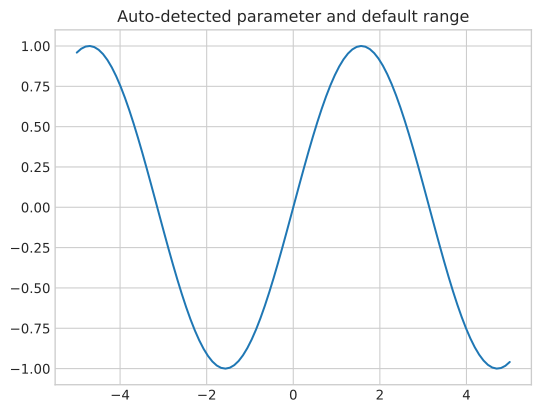
# Custom range and multiple functions
fig, ax = plt.subplots(figsize=(6, 4))
fplot(sp.sin(x), range=(-10, 10), ax=ax, color='blue', label='sin(x)')
fplot(sp.cos(x), range=(-10, 10), ax=ax, color='red', label='cos(x)')
ax.legend()
ax.grid(True)
plt.show()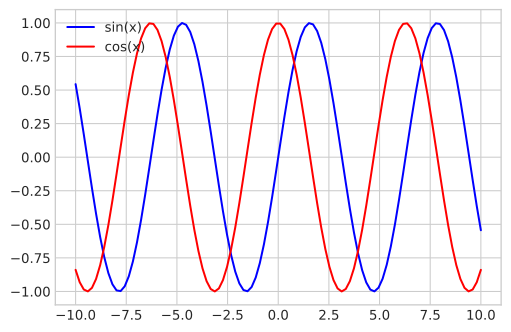
Parametric Curves
t = sp.Symbol('t')

# Circle
fplot(sp.cos(t), sp.sin(t), range=(0, 2*np.pi))
plt.axis('equal')
plt.title('Parametric Circle')
plt.grid(True)
plt.show()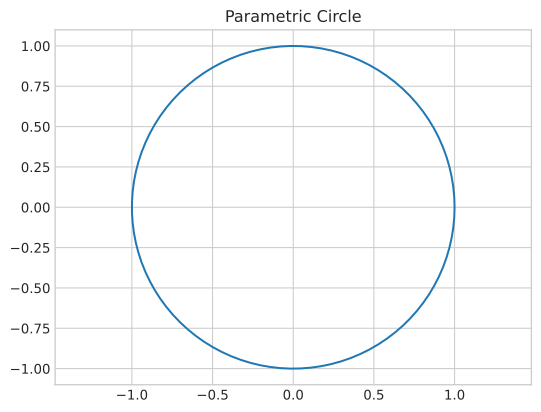
# Spiral with higher resolution
fplot(t*sp.cos(t), t*sp.sin(t), range=(0, 4*np.pi),
      color='darkgreen', linewidth=2, npoints=500)
plt.axis('equal')
plt.title('Archimedean Spiral')
plt.grid(True)
plt.show()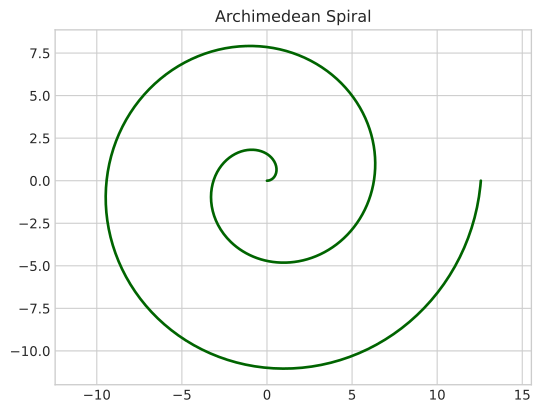
# Lissajous curves

fig, axes = plt.subplots(1, 3, figsize=(15, 5))

for idx, (a, b) in enumerate([(2, 3), (3, 4), (5, 4)]):
    ax = axes[idx]
    fplot(sp.sin(a*t), sp.sin(b*t), range=(0, 2*np.pi),
          ax=ax, color='purple', linewidth=2, npoints=500)
    ax.set_aspect('equal')
    ax.set_title(f'a={a}, b={b}')
    ax.grid(True)

plt.tight_layout()
plt.show()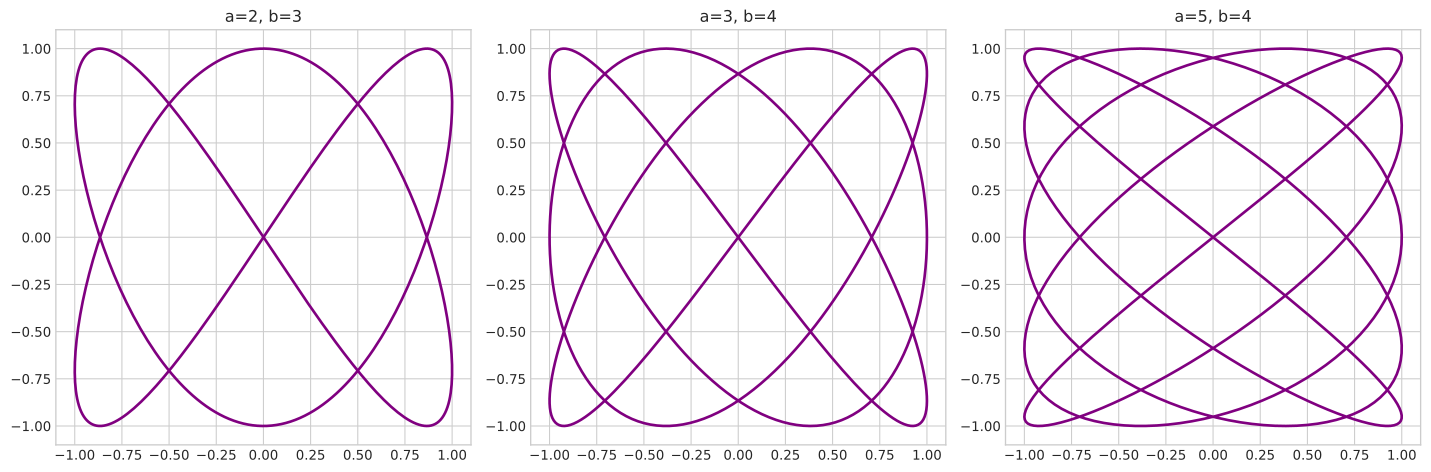
Engineering Applications
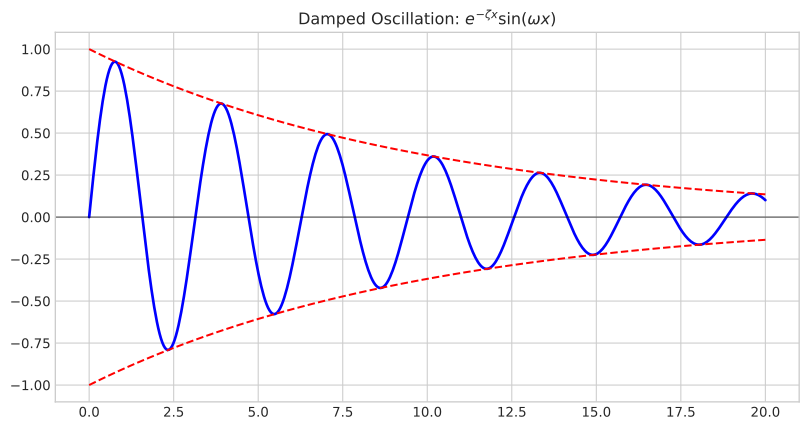
# Damped oscillation
omega, zeta = 2, 0.1
fig, ax = plt.subplots(figsize=(10, 5))

fplot(sp.exp(-zeta*x)*sp.sin(omega*x), range=(0, 20),
      ax=ax, color='blue', linewidth=2, npoints=500)
fplot(sp.exp(-zeta*x), range=(0, 20),
      ax=ax, color='red', linestyle='--', label='Envelope')
fplot(-sp.exp(-zeta*x), range=(0, 20),
      ax=ax, color='red', linestyle='--')

ax.set_title(r'Damped Oscillation: $e^{-\zeta x}\sin(\omega x)$')
ax.grid(True)
ax.axhline(0, color='k', linewidth=0.5)
plt.show()